Why AI Emails Sound Fake — and How to Fix Them
AI-written email is the kind of thing nobody warns you about with all the robotic filler and corporate fluff flying around. I’ve watched people hit delete on AI-drafted emails mid-send for about three years now. The subject line looks fine. The structure is logical. Then they read it aloud and something just breaks. They can’t quite name it — but they feel it. That email doesn’t sound like them.
Here’s the thing: it’s not some mysterious flaw baked into the technology. It’s a pattern problem. And once you see it, you can fix it in under two minutes.
What Makes an AI Email Feel Off
That opening pleasantry no actual human wrote on purpose. “I hope this email finds you well” is the tell. Real people stopped writing that around 2008, give or take. AI defaults to it because it appears in thousands of training emails from people who felt obligated — not authentic. Delete it every time.
Sentences that all weigh exactly the same. AI loves symmetry. Subject-verb-object. Subject-verb-object. Same length. Same rhythm. Read a draft aloud and you’ll hear it — the mechanical cadence of someone who learned English from a grammar textbook rather than from actual conversations. It’s uncanny in a bad way.
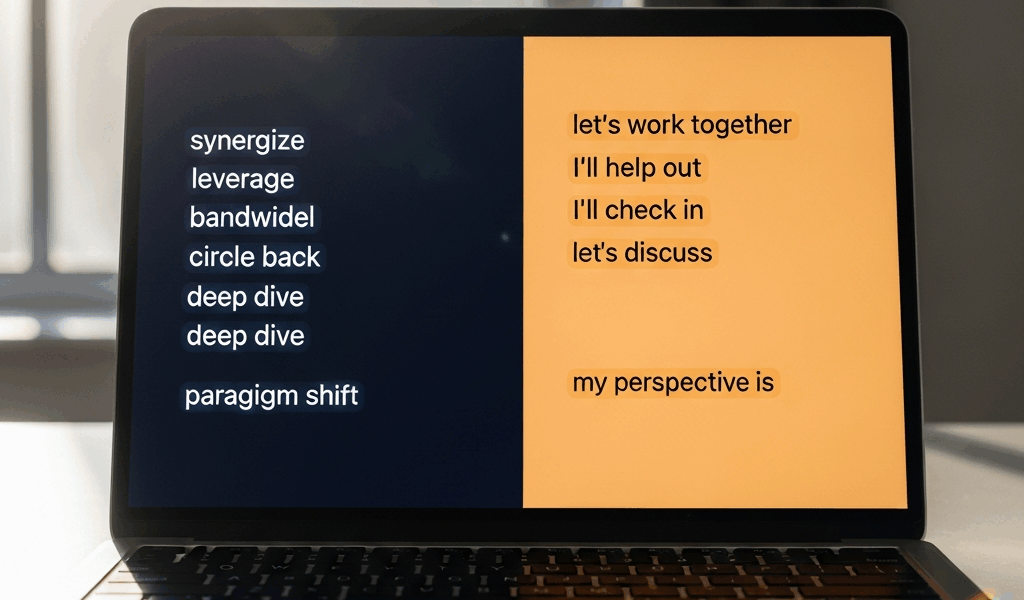
Hollow power words with nothing real underneath them. “Synergize.” “Leverage.” “Circle back.” “Touch base.” These show up constantly in AI drafts because they’re common in business email training data. But real professionals use them sparingly — and only when they actually mean something. An email stuffed with these sounds like a parody of a corporate memo from 2003.
The missing detail only you would know. A real email to a colleague mentions the client’s weird request from last Tuesday, or that one spreadsheet number, or the joke that landed badly at the morning standup. AI has zero access to that context. So the email stays generic — something you could technically send to anyone. That’s the dead giveaway.
The Prompt Is Usually the Real Problem
Let me back up — this is what matters. Most people blame the AI for sounding robotic when the actual culprit is the input they gave it. Vague in, vague out. Every time.
Vague prompt: “Write a follow-up email to a prospect who went silent.”
Output: “I wanted to reach out and check in on our previous conversation regarding your project timeline. I’m confident that a partnership with our firm would bring significant value to your organization. Please let me know if you’d like to reconnect.”
Now watch what specificity does:
Specific prompt: “Write a follow-up to Sarah at Beacon Marketing. She said last month she’d have budget approval by now — total radio silence since. I know her team just launched a rebrand (saw it on LinkedIn). Keep it under 50 words. Sound genuinely curious about how the launch went, not desperate.”
Output: “Sarah, saw the rebrand launch on LinkedIn — solid work. How did the team pull that off on the timeline you mentioned? Also, did the budget conversation move forward on your end? No pressure either way.”
Shorter. Specific reference. Zero corporate fluff. The difference isn’t the AI — it’s the detail you put into the request. Before you paste anything into ChatGPT, tell it one specific thing only you actually know. Your AI will use it. Your email will sound like you wrote it.
Five Fixes You Can Apply in Under Two Minutes
- Delete the opening pleasantry. If your draft starts with “I hope this email finds you well” or “Thank you for taking the time” — gone. Start with your actual point or a specific observation. People notice when you respect their time, even if they can’t say why.
- Add one fact only you know. Drop in a detail about the recipient, the situation, or something you genuinely observed. “I noticed you were at the DevOps conference last Thursday” or “Your last message mentioned the API delays specifically” — this anchors the email in reality and kills the generic feeling immediately.
- Replace passive voice with active. Scan for “it is believed,” “it has been noted,” “there are concerns.” Replace each one with who’s actually doing what. “We’re concerned” beats “There are concerns.” Shorter, more human, faster to read — three things AI drafts rarely manage simultaneously.
- Shorten the sign-off. AI loves a three-line closing: “Looking forward to hearing from you. Please let me know if you have any questions. Best regards, [Name].” Cut it to one line. Just your name, maybe “Thanks” or “Cheers.” The redundancy is the real problem, not the formality.
- Read it aloud as a gut-check. If you stumble mid-sentence or hear yourself sounding like a corporate chatbot, rewrite that sentence in words you’d actually use in conversation. Your ear catches what your eyes miss — every time.
Before and After — Two Real Email Rewrites
Cold Outreach Email
AI Draft (Sounds Fake):
“Hi Marcus, I hope this email finds you well. I came across your profile on LinkedIn and was impressed by your work in cloud infrastructure optimization. I believe there would be significant synergies between our consulting firm and your organization. I’d love to schedule a call at your earliest convenience to discuss how we might collaborate. Looking forward to hearing from you. Best regards, Jennifer”
What Changed: “I hope this email finds you well” — deleted immediately. Added a specific detail pulled from an actual case study on the Kubernetes migration. Replaced “significant synergies” with a concrete offer. Cut the three-line closing down to one.
Human-Edited Version:
“Marcus, I read your case study on the Kubernetes migration at TechCorp — the way you handled the state management problem was clever. We help companies with that exact bottleneck. Worth a 20-minute call? Jennifer”
Internal Update Email
AI Draft (Sounds Fake):
“Hi Team, I wanted to provide you with an update on the Q4 project status. We have made significant progress on the development phase, and the timeline is on track for delivery. There are a few outstanding items that require attention, and I will circle back with more details next week. Thank you for your continued efforts. Best regards, David”
What Changed: Removed “I wanted to provide you with an update” — says nothing, wastes a line. Added the actual blocker (API docs from Stripe, specifically). Replaced “outstanding items” with what’s genuinely stuck. Trimmed everything down to direct language.
Human-Edited Version:
“Team — Q4 project is on schedule. The one slow point: we’re still waiting on API documentation from Stripe for the payment module integration. I’ll follow up with them by Wednesday. Everything else is moving. David”
Same fix in both cases. Remove the filler, add the specific fact, use words you’d actually say out loud. The email becomes yours again.
When to Stop Editing and Just Write It Yourself
Don’t make my mistake of running everything through AI first and editing later. Some emails shouldn’t go near it at all.
If the message is an apology, a sensitive conversation, relationship repair, or feedback that might sting — write it yourself from scratch. These need your voice and your judgment on tone. AI will give you something that sounds formally sorry. Not actually sorry. There’s a real difference, and people feel it.
Also skip AI for anything under 50 words or so. Writing it yourself is faster than prompting, waiting, reading, and editing. The prompt itself becomes the busywork. I’m apparently a slow editor, and drafting short emails manually works for me while the prompt-and-edit loop never quite does.
Simple rule: use AI for volume — follow-ups, status updates, new client outreach. Write it yourself for stakes — apologies, difficult feedback, anything relationship-critical. Your gut already knows which bucket the email belongs in. Trust it.
The real fix to fake-sounding AI emails isn’t better AI. It’s you taking 90 seconds to add one specific detail and cut the corporate fluff. That’s genuinely it.



Leave a Reply