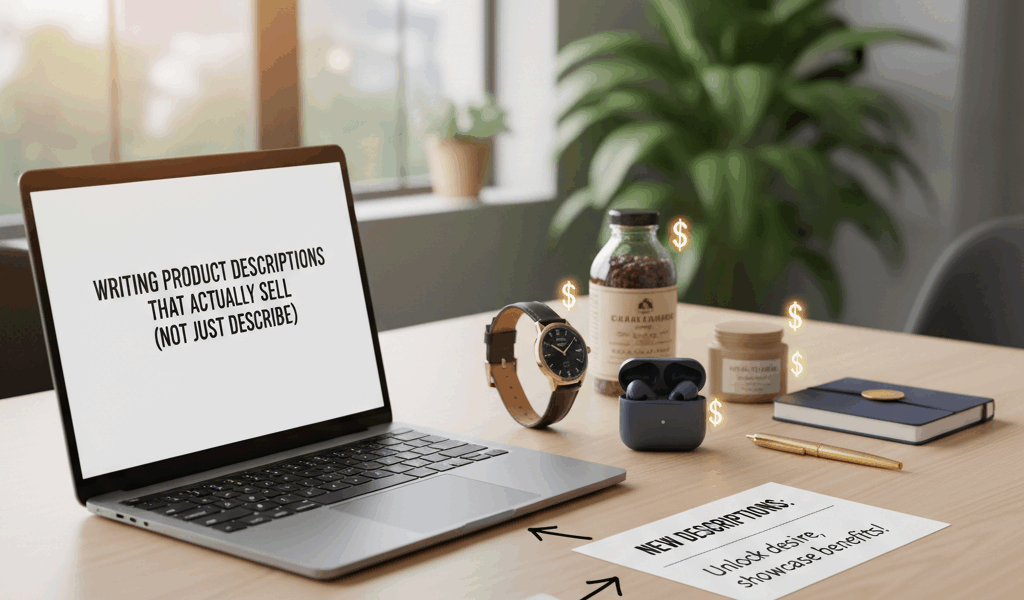
Product description writing has a specific version of the AI problem that content writing doesn’t: every word is adjacent to a buy button, which means the cost of generic, unconvincing copy is directly measurable in conversion rate rather than just in “engagement.” As someone who has written a lot of e-commerce copy and spent time figuring out where the AI default output fails, I learned what the prompts need to do differently. Today I’ll share them.

Most product descriptions describe. The ones that sell do something different: they put the reader inside the experience of owning the product before they’ve bought it. Here’s the difference in practice and the prompts that get you there.
Describing vs Selling: The Actual Difference
A describing product description: “The Ember Mug 2 is a 14oz temperature-controlled mug with up to 80 minutes of battery life.”
A selling product description: “Your coffee is still the right temperature an hour after you poured it. You forgot about it during a call, got pulled into a meeting, and when you finally remembered — it was still good.”
Both are accurate. One makes you want to buy it. The difference is where the description starts: at the product’s features, or at the customer’s experience. The second version requires the copy to begin where the customer is.
The Prompt Architecture That Changes the Output
Prompt: “Write a product description for [product] that: (1) opens with the specific moment or problem the customer is in when they realize they need this — not the product itself, (2) describes the experience of having it rather than the features of it, (3) addresses the most common objection or hesitation someone has before buying, and (4) closes with what changes after they have it. Don’t start with the product name or a feature. Under 150 words.”
The “opens with the moment” instruction is the single most important structural change in this prompt. It forces the copy to start where the customer is, not where the product catalog is. That shift is what makes a description feel like it was written for a reader.
The Objection Paragraph
Most descriptions skip the objection. The ones that convert well address it directly in one or two sentences: “Yes, it’s $150 for a mug. But you’ll use it every single day for five years, and the math on that is different than the sticker price suggests.” Prompt: “What’s the most common reason someone hesitates before buying [product]? Write a one-sentence acknowledgment of that hesitation followed by the most compelling counter-argument in one additional sentence.”
For Catalogs: The Batch Template
When you have 50+ products to write, individual crafted prompts aren’t practical. Build a master template: “You’re writing product descriptions for [brand]. Voice: [adjectives]. Customers: [description]. Using this spec [paste], write a description that opens with the customer’s experience, is under [word count], and never uses the words ‘premium,’ ‘high-quality,’ or ‘perfect for.'”
The word ban is doing important work. “Premium,” “high-quality,” and “perfect for” are the three most common filler phrases in AI product copy and they read as generic the moment a real customer sees them. Banning them forces the AI toward specificity.
The Edit Pass
After generating, read each description for one thing: does it make you want the product? Not “is it accurate” — is it compelling? If not, find the sentence where it stops being interesting. That’s usually the second paragraph, where AI tends to retreat from specific experience back to general feature list. Rewrite from there. That single edit pass is the difference between copy that describes and copy that sells.



Leave a Reply