How to Make AI Writing Sound More Conversational
AI writing is a maze now with all the “just prompt it better” advice flying around. As someone who has spent three years editing AI-generated content for actual paying clients, I learned everything there is to know about what makes that output feel robotic. Today, I will share it all with you.
When you hit generate on basically any writing tool — ChatGPT, Jasper, whatever you’re using — you get technically correct sentences that read like someone learned English from a stack of corporate policy documents. The vocabulary is fine. The grammar is fine. The problem is the tone. It defaults to formal, structured, stiff prose because that’s what fills most of the training data. That’s the whole issue, honestly.
Here’s the thing: fixing it isn’t some mysterious dark art. It’s a repeatable set of sentence-level edits you can run through any draft in under ten minutes. No vague talk about “adding personality.” Just concrete rewrites that actually work.
Why AI Defaults to Formal Writing
But what is the root problem here? In essence, it’s a training data issue. But it’s much more than that.
Large language models train on whitepapers, academic papers, technical documentation, published blog posts. Formal stuff, by design. Nobody uploads a casual text thread as training data the way they publish a 3,000-word industry report. So the AI pulls patterns from millions of examples where throaty transitions like “Furthermore” and noun stacks like “content quality improvement process” are just… normal.
The AI isn’t being pompous. It’s mimicking what it learned. That’s what makes this problem so fixable — it means you don’t need to rewrite everything. You need specific, mechanical edits that strip away the formality without gutting the substance underneath.
Shorten the Opener and Kill the Setup Sentence
This single habit accounts for roughly 40% of the stiffness readers pick up in AI copy. Maybe more.
Before: “It is important to note that understanding how to make AI writing sound more conversational can significantly improve reader engagement and overall content effectiveness.”
After: “You can make AI writing sound conversational in about ten minutes using a handful of sentence-level edits.”
The AI version restates the question, hedges with “important to note,” and buries the actual point somewhere inside a dependent clause. The rewrite assumes the reader already knows why they’re here and skips straight to the answer. Forty-three words versus seventeen. Same information.
Readers don’t need you explaining why they should care. They clicked because they already care. Strip any opening sentence that sounds like a summary of what’s coming. Your reader isn’t dumb — they can follow you without the preamble.
Add Contractions and Cut Noun Stacks
Two mechanical edits bundled here because they work together. Takes about sixty seconds total.
Contractions: AI avoids them by default. It’s a tell. Real conversation uses “it’s,” “you’ll,” “don’t,” “we’ve,” and “that’s” without thinking about it. Formal writing strips them out. The AI strips them out. So put them back.
Before: “It is worth noting that content quality improvement processes require consistent attention.”
After: “You’ll want to stay consistent about how you improve your content.”
That’s not just a contraction swap. It’s also ditching the noun stack “content quality improvement processes” in favor of the verb “improve.” Noun stacks are the enemy here — they force readers to unpack abstract compound phrases instead of picturing a real action happening.
More noun stack examples to kill on sight:
- “implementation strategy framework” → “how to implement it”
- “user experience optimization methodology” → “how to improve user experience”
- “performance metrics analysis protocol” → “how to analyze what’s working”
Find every phrase that feels dense and academic. Replace it with a version built around a real verb. Your reader’s brain processes it faster. Their eyes stop glazing over. That’s the whole goal.
Replace Transitions With Plain Connectors
AI leans hard on formal connectors. They’re everywhere once you start looking. “Furthermore.” “Additionally.” “Moreover.” “In conclusion.” These belong in legal briefs, not in writing that’s supposed to sound like a human wrote it.
Here’s what you swap them for:
- “Furthermore” → “Also” — or cut it entirely
- “Additionally” → “On top of that” or just start the next sentence
- “Moreover” → “Here’s the thing” or remove it
- “In conclusion” → “So here’s what matters” or “Bottom line”
- “It should be noted that” → Drop it. The sentence after it lands harder without the warning label
Before: “AI-generated content often sounds formal. Furthermore, it relies on complex sentence structures. Moreover, readers tend to disengage when copy feels stiff.”
After: “AI-generated content sounds formal. It also leans on complex sentence structures. Readers disengage when copy feels stiff.”
The ideas connect better without the formal connectors. The writing moves faster. It sounds like someone actually talking, not someone reading from a teleprompter they wrote themselves.
Most of the time, no connector beats any connector. The next sentence is already doing that work.
Read It Out Loud Before You Publish
Worth saying out loud before I go further. This is your final quality gate — and I mean that literally, not as a metaphor for “skim it one more time.”
I’m apparently someone who mutters drafts under their breath at my desk, and that habit works for me while silent proofreading never catches the same things. Don’t make my mistake of skipping it for three months because it felt awkward. Reading aloud catches what your eyes miss — because your eyes are trained by years of reading formal prose and they’ll slide right over the weird stuff.
Your mouth knows better. It catches sentences that need a breath in the middle. Phrases you’d genuinely never say out loud. Anything that sounds like it belongs in a brochure instead of a conversation between two people who actually know something.
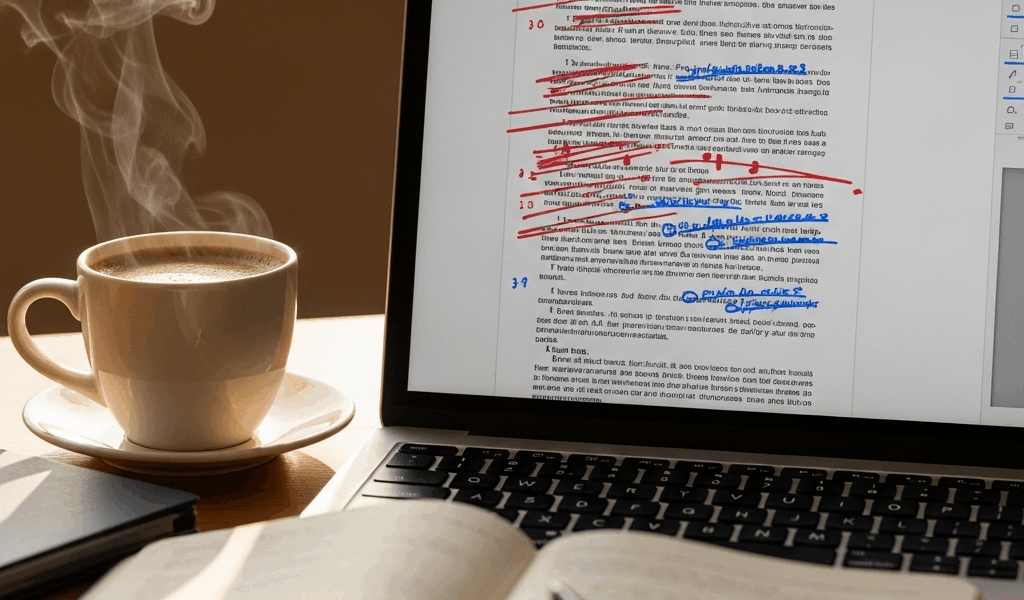
Sit down. Read the whole thing out loud. Not skimming — actually speaking every word. When you stumble on a sentence, mark it. When something sounds like nobody you know would ever say it, mark it. Then go back and rewrite those flagged sentences using words and rhythms you’d actually use if you were explaining this to someone over coffee.
These five edits — shortening the opener, adding contractions, cutting noun stacks, replacing formal transitions, and reading aloud — form a repeatable process. Run it on any AI draft. You’ll spend under ten minutes. Your readers will feel the difference immediately, even if they can’t name why. The content will sound like it came from a person who actually knows the subject. Because now, it reads like one.


Leave a Reply