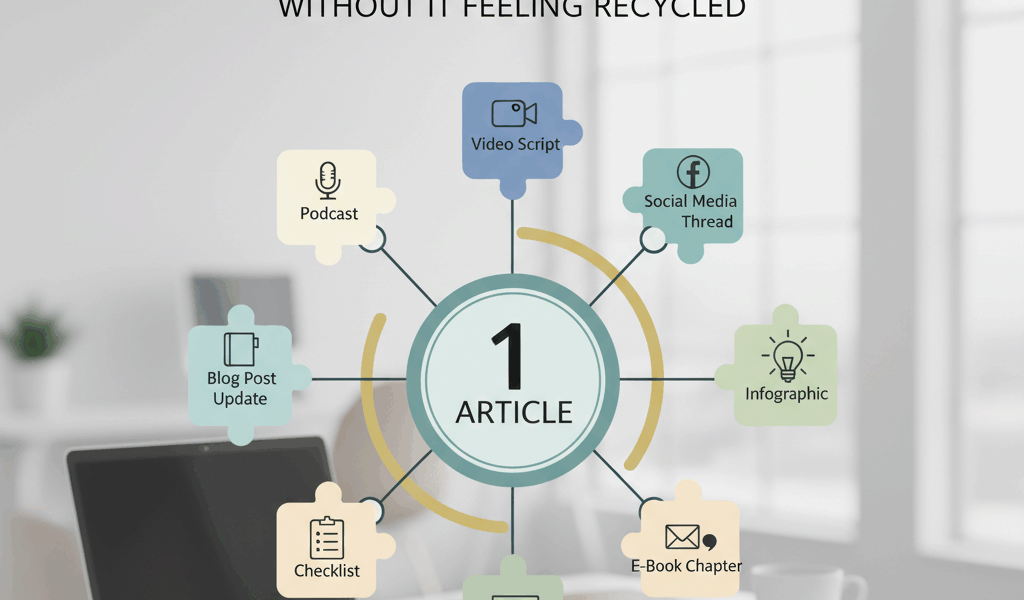
Content repurposing advice has gotten stuck at “turn your blog post into a Twitter thread,” which is fine as far as it goes and doesn’t go very far. As someone who spent a long time leaving most of the value in a finished piece sitting there unused, I learned that real repurposing isn’t about reformatting — it’s about extracting different angles from the same source material. Today I’ll share the nine-piece system I actually use, including how to make each piece feel original rather than recycled.
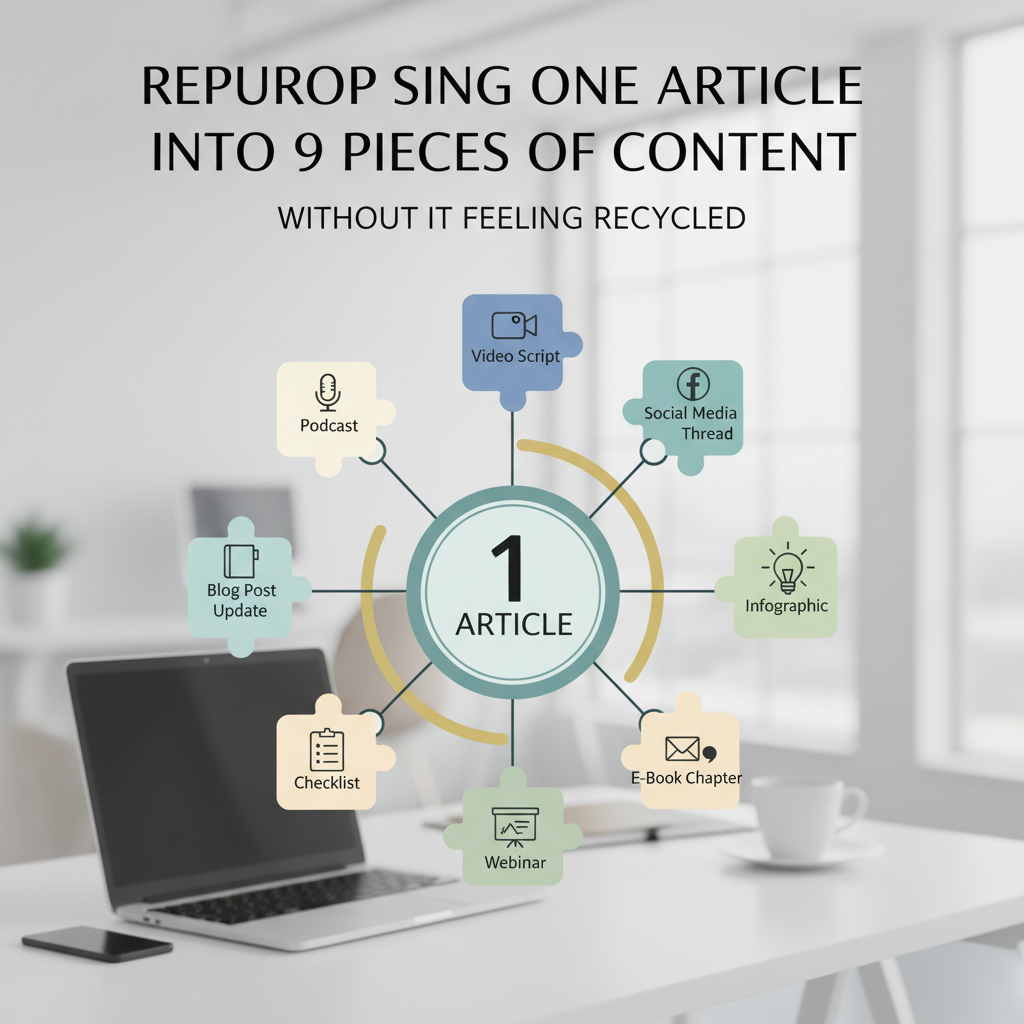
A 1,500-word article has multiple arguments, multiple examples, multiple implied questions it doesn’t answer. Each of those is a separate content opportunity. Here’s how to pull them out.
Why Most Repurposing Feels Recycled
Most content repurposing is just reformatting: take the blog post, shrink it, put it somewhere else. The result feels recycled because it is — the same ideas in a shorter package. Readers who’ve seen your original piece notice. Readers who haven’t get an incomplete version of something that wasn’t designed for the format they’re reading it in.
The fix is extracting different angles from the same source material, not reformatting the same angle.
The 9 Pieces
1. The contrarian take. Find the most counterintuitive claim in your article. Build a short-form post around defending that one claim with a single strong example. Prompt: “From this article [paste], identify the most counterintuitive claim. Write a 150-word LinkedIn post that leads with it and defends it with one specific example.”
2. The checklist. Any article with practical steps becomes a checklist people save. Strip the explanation, format as quick-reference. People bookmark the version they can scan at the moment they need it.
3. The newsletter intro. The opening hook — the part you worked hardest on — makes a strong newsletter intro for a related issue. The setup is done; connect it to something timely and you have a natural opening.
4. The quote card. Find the single sentence that could stand alone. One good sentence from a strong article is often more shareable than the full article.
5. The question post. Your article answers questions. Those questions stripped of their answers make engagement posts. “What’s your approach to [problem your article solves]?” drives comments and links back organically.
6. The expanded section. Pick one section you had to compress due to length. Write a standalone deep-dive on that section alone. The original becomes a source rather than the destination.
7. The opposing view. Write a short piece taking the other side of your article’s main argument. “Here’s the counterargument I didn’t include” is genuinely interesting and reaches readers who disagreed with the original.
8. The case study version. Replace general principles with one specific example illustrating the same points. Same structure, different framing — often reaches a different reader than the principles version.
9. The email pitch. Summarize the main point in three sentences and use it as a personalized outreach email to someone who should see it. Drives distribution rather than content creation, but it’s a legitimate repurpose of the research investment.
Making Each Piece Feel Original
Add this instruction to every repurposing prompt: “This should stand alone — a reader who never saw the original article should get full value without feeling like they’re missing context.”
That constraint forces the output away from “here’s a summary” and toward “here’s an independent piece that happens to share source material.” That distinction is what makes the difference between content that feels fresh and content that feels like reheated leftovers.
Honest time estimate: 60–90 minutes for all nine passes. You’ll probably publish six of the nine. Six additional pieces from one article investment is the math that makes this worth building into a regular workflow.




Leave a Reply