
Newsletter writing workflows have gotten unnecessarily painful, with most advice either treating the problem like it’s a creativity crisis or recommending AI tools that produce something you still have to rewrite from scratch. As someone who used to spend four days spread across two weeks producing a single month of newsletters — research, drafts, second-guessing, editing — I learned what actually compresses the process without degrading the output. Today I’ll share the exact workflow that gets it done in one afternoon.

The key distinction: AI handles the structural and generative work. You handle the voice and judgment. Here’s how the afternoon breaks down.
The Setup That Makes Everything Else Work
Before running a single prompt: write down your newsletter’s core topic, your audience description, and the last 8 topics you’ve covered. If your audience definition is “marketing professionals,” make it more specific — “solo consultants doing B2B content strategy who are trying to scale past trading time for money.” The more specific the brief, the better every prompt performs downstream. This takes 20 minutes and it’s the most leveraged 20 minutes in the process.
Step 1: Generate the Month’s Topic List (20 minutes)
Prompt: “I write a weekly email newsletter for [audience]. My newsletter covers [topic area]. Here are the last 8 topics I covered: [list]. Generate 4 new newsletter topics that are: (1) different from my recent coverage, (2) specific enough that someone reading the subject line knows exactly what they’d learn, and (3) relevant to [a current problem or question your audience is dealing with]. For each, give me a draft subject line and a one-sentence main takeaway.”
Pick the four you’d most want to read. Discard the rest. The AI will usually produce two obvious topics and two you wouldn’t have thought to write — the second category is where this step earns its time.
Step 2: Outline Each Issue (10 minutes each)
Prompt: “I’m writing a newsletter issue about [topic] for [audience]. Target length: [e.g., 400 words, 3-minute read]. Give me: an opening hook that doesn’t start with ‘I’ or a question, 3–4 main points with the core insight for each, and a closing that ends with something actionable rather than a generic CTA.”
The “doesn’t start with ‘I’ or a question” constraint forces the AI away from the two most overused newsletter opening patterns and toward something with more pull. Small instruction, noticeable difference in output.
Step 3: Draft Each Issue (15–20 minutes each)
Prompt: “Using this outline [paste], write the full newsletter issue in a voice that is [describe yours — e.g., direct and slightly irreverent, warm but not chatty]. Short paragraphs. Avoid bullet lists unless genuinely necessary. Write like you’re sending this to one specific person, not a list.”
The “one specific person” instruction is probably the most important single prompt instruction I use regularly. It shifts the AI from broadcast mode into correspondence mode, and the resulting tone is different from the first sentence.
Step 4: Edit for Voice (10 minutes each)
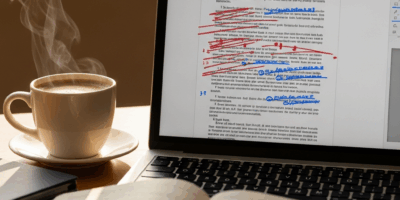
Read the draft out loud. Mark every sentence that doesn’t sound like you. Rewrite those — don’t reprompt them, write them yourself. Add the specific example or aside that only you would include. This is the step you can’t skip. The ratio varies: some people rewrite 20% of the draft, some rewrite 60%. What matters is that the finished issue sounds like it came from a person with opinions, not a model with patterns.
Step 5: Subject Lines (10 minutes for all four)
Prompt: “Write 5 subject line options for a newsletter about [topic]. They should: create curiosity without being clickbait, be under 50 characters if possible, and feel like they’re from a person rather than a marketing department. Don’t start with numbers, emojis, or the word ‘how.'”
Pick the one you’d open if you didn’t know what was inside. That’s the test.
Full afternoon schedule: 20 minutes on topics, 40 minutes on four outlines, 90 minutes on four drafts, 40 minutes editing, 10 minutes on subject lines. Under four hours. Four newsletters scheduled, done.


Leave a Reply