
AI research workflows have gotten way more cluttered than they need to be, with everyone selling prompt templates and systems that mostly amount to “ask it better questions.” As someone who writes constantly and spent a long time producing shallow AI output before figuring out what was actually missing, I learned that the problem is almost never the writing prompt — it’s the three prompts that should come before it. Today I’ll share the system I actually use.
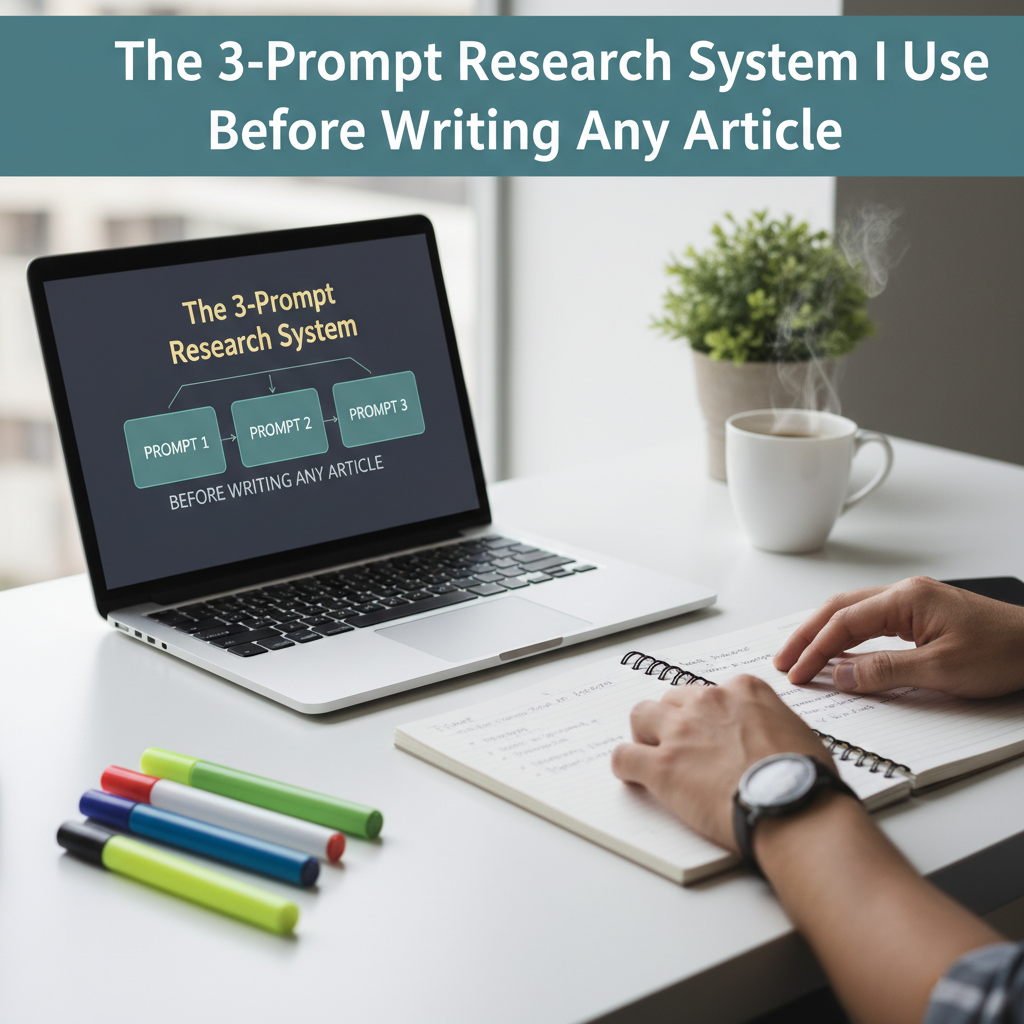
When you skip straight to “write me an article about X,” you get the AI’s averaged understanding of the topic — the content equivalent of the Wikipedia opening paragraph. When you run research prompts first, you get something with actual depth. Here’s the sequence.
Why Research Prompts Are Different From Writing Prompts
Writing prompts ask AI to produce. Research prompts ask it to surface, organize, and stress-test what it knows. These are fundamentally different tasks and they reward different framing. That distinction is what makes the difference between AI output that sounds confident and AI output that actually is confident.
Prompt 1: The Landscape Prompt
The first prompt establishes what the territory looks like before you start mapping it.
Template: “I’m writing an article about [topic] for [audience]. Before I start, give me: the 5 most common questions people have about this topic, the 3 most common misconceptions, and the 2 things experts talk about that most beginners miss.”
You’re asking the AI to pre-load the most useful structural information before you’ve committed to a structure. The misconceptions section is especially valuable — it tells you where your readers are probably starting from, which gives you anchor points for the whole piece. Run this and read it carefully before doing anything else. I’m apparently someone who consistently finds a better article angle here than the one I started with.
Prompt 2: The Source and Specificity Prompt
Template: “What are the most specific, concrete examples, case studies, or data points that support or complicate [main claim from Prompt 1]? Give me statistics with context, named examples, and any exceptions or counterarguments worth acknowledging.”
This forces the AI off vague assertion and into evidence. “Studies show that X is effective” is useless. “A 2023 study found X, though limited to [context]” is something you can work with and verify.
Important caveat: verify anything specific before publishing. AI models hallucinate statistics and misattribute quotes at a rate that should make you paranoid. This prompt is a specificity-hunting prompt, not a fact-finding replacement. It tells you what to go verify — not what you’ve already verified.
Prompt 3: The Angle Stress-Test Prompt
Template: “I’m planning to argue [your intended angle or thesis]. What are the strongest counterarguments? What would someone who disagrees say, and what evidence would they cite? What’s the most common mistake people make when thinking about this?”
I’m burying the lede a bit — sorry. This prompt also tends to produce the most interesting section of the finished piece — the honest complication that makes content feel real rather than promotional.
How to Use the Output
After all three prompts: you have a structural map of the topic, specific examples to verify, and a pre-loaded set of counterarguments to address. Write your outline from this material. The article almost always structures itself — you’re not starting from blank, you’re editing a research document into a narrative. That shift in starting position is what changes the finished piece.
Total time for the three prompts: 10–15 minutes. The difference in depth of the resulting article: enough that skipping them now feels like skipping the foundation before building the house.




Leave a Reply